

Preparing Children for Learning Through Early Intervention and School Readiness Programs
Introduction
The early years of a child’s life are critical for developing communication, learning, social, and independence skills. Children learn at different rates, and some may require additional support to achieve important developmental milestones. Early support through structured intervention programs can help children build the skills necessary for successful participation at home, in school, and in the community.
At Dimensions Centre for Child Development, intervention services are designed to meet children at their developmental level and support their individual needs through two specialized programs: the School Readiness Program (SRP) and the Early Intervention Program (EIP).
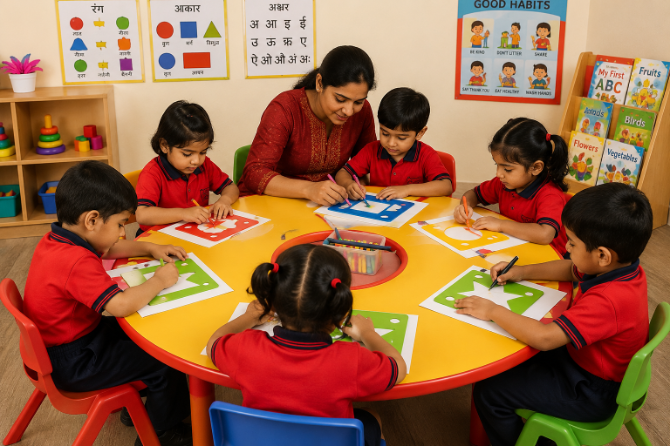
School readiness refers to a child’s preparedness to successfully participate in academic, social, emotional, and behavioural aspects of school. For children with special needs, school readiness extends beyond academic skills and includes communication, social interaction, self-regulation, motor abilities, and adaptive functioning. Early intervention services and school readiness programs play a critical role in identifying developmental delays and providing timely support during the sensitive periods of brain development.
Importance of School Readiness Programs
School readiness programs aim to equip children with foundational skills required for successful school participation. These programs are particularly beneficial for children with developmental disabilities, autism spectrum disorder, speech-language disorders, intellectual disabilities, and other special needs.
Key Benefits
- Early communication and language development
- Social interaction and play skills
- Joint attention and listening skills
- Following simple instructions
- Early cognitive and problem-solving abilities
- Fine motor and pre-writing readiness skills
- Independence in daily routines
According to the work of Pianta, Cox, and Snow (2007), school readiness encompasses not only cognitive skills but also emotional regulation, social competence, and learning-related behaviours that contribute significantly to academic success.
Importance of Early Intervention
Early intervention refers to specialized services provided for young children who have developmental delays or disabilities.
Benefits of Early Intervention
- Functional communication skills
- Classroom participation and learning behaviours
- Social communication and peer interaction
- Attention and task completion
- Problem-solving and reasoning skills
- Emotional regulation and behavioural flexibility
- Independence and self-management skills
- Academic readiness and functional literacy skills
Research by Michael J. Guralnick (2011) emphasizes that early intervention significantly improves developmental outcomes by addressing risk factors before they become more pronounced. Similarly, Shonkoff and Phillips (2000) highlighted that experiences and interventions during early childhood have lasting effects on learning and development.
Relationship Between School Readiness and Early Intervention
School readiness programs and early intervention are closely interconnected. Early intervention helps children acquire foundational developmental skills, while school readiness programs prepare them to apply these skills within educational environments.
Why These Programs Matter
Research demonstrates that targeted intervention during childhood can significantly improve communication, social participation, learning outcomes, and independence. Early and consistent support allows children to develop the skills needed to engage more effectively in educational settings and everyday activities.
Children benefit when intervention focuses not only on academic learning but also on communication, social relationships, emotional development, and independence.
How Parents Can Support Learning at Home
Parents can strengthen intervention outcomes by:
- Reading and discussing books together
- Encouraging communication during daily routines
- Providing opportunities for turn-taking games
- Supporting independent self-help activities
- Limiting passive screen time and encouraging active play
- Establishing predictable daily routines
- Creating opportunities for social interaction with peers
Consistent practice in natural environments helps children generalise newly learned skills and become more confident learners.
Conclusion
School readiness programs and early intervention are essential components of support for children with special needs. They provide children with the foundational skills necessary for successful participation in educational settings and promote positive developmental outcomes. Evidence from the literature suggests that early, individualised, and family-centred interventions contribute significantly to improvements in communication, cognition, social competence, and academic readiness.
At DCCD, we are committed to providing evidence-based, child-centred intervention services that support each child’s unique developmental journey. Our School Readiness Program and Early Intervention Program are designed to empower children and families through meaningful, goal-directed therapy.
References
- Guralnick, M. J. (2011). Why early intervention works: A systems perspective. Infants & Young Children, 24(1), 6–28.
- Pianta, J. C., Cox, M. J., & Snow, K. L. (2007). School Readiness and the Transition to Kindergarten in the Era of Accountability. Paul H. Brookes Publishing.
- Shonkoff, J. P., & Phillips, D. A. (2000). From Neurons to Neighborhoods: The Science of Early Childhood Development. National Academy Press.
- Snow, K. L. (2006). Measuring school readiness: Conceptual and practical considerations. Early Education and Development, 17(1), 7–41.
- Duncan, G. J., et al. (2007). School readiness and later achievement. Developmental Psychology, 43(6), 1428–1446.
- World Health Organization. (2020). Improving Early Childhood Development: WHO Guideline.
- UNICEF. (2019). Early Childhood Development and School Readiness.
- Division for Early Childhood. (2023). Recommended Practices for Early Intervention and Early Childhood Special Education.
- National Association for the Education of Young Children. (2020). Developmentally Appropriate Practice Position Statement.